Why Are Brazilian Brands Still So Little Seen in the Middle East?
From a Historical Distance to a New Opportunity for Brazilian Exports
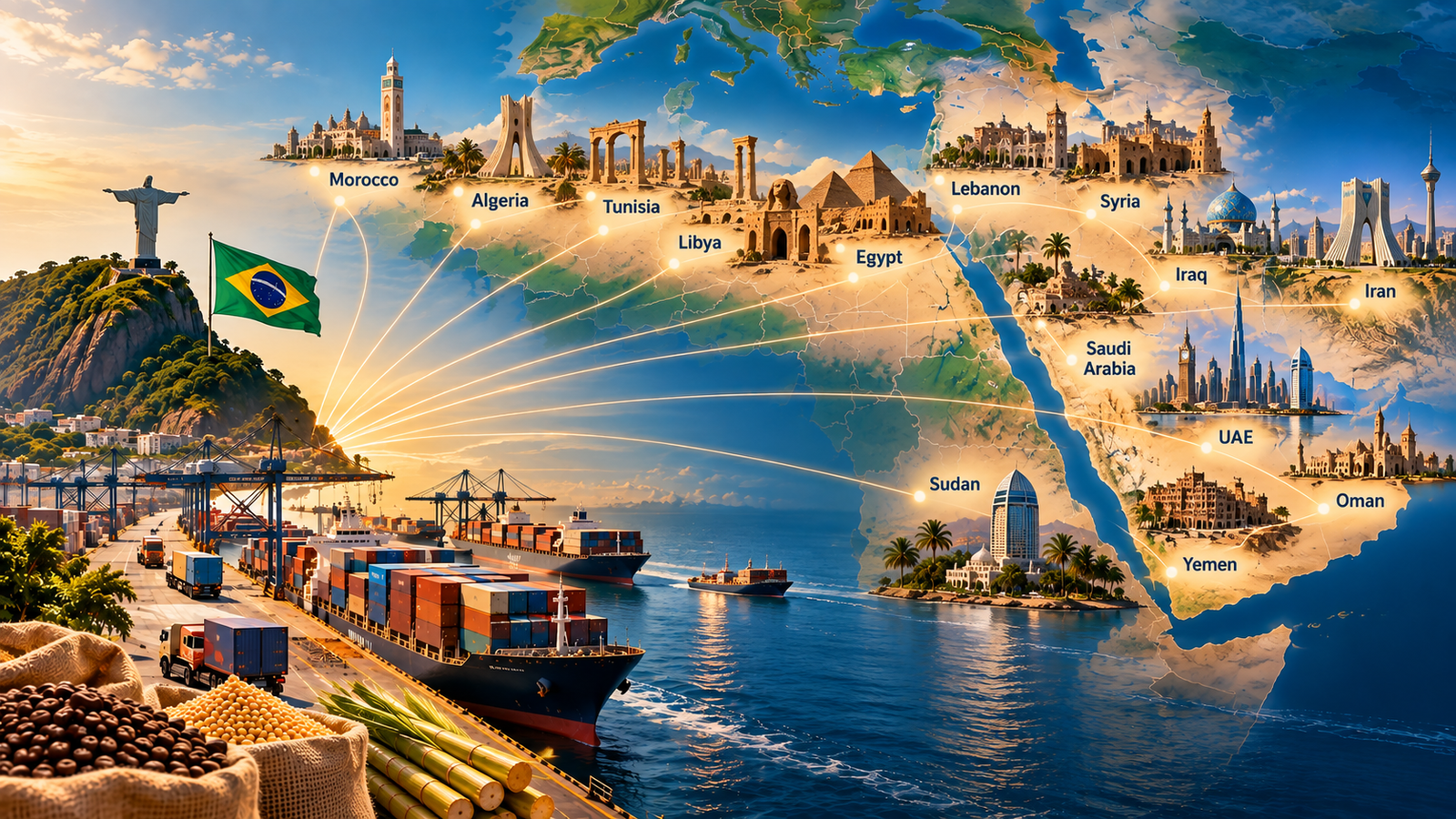
Walk into a supermarket in almost any Arab country today and you are likely to find a wide range of Turkish, Indian, European, American and Asian products. Turkish chocolates, Indian tea, Pakistani rice, European food products and major American chains are all familiar to consumers across the region.
But one question has stayed with me for years:
Where is Brazil in this picture?
Brazil is one of the world’s leading food producers. Brazilian coffee, sugar, soybeans, meat, vegetable oils and many other agricultural products have a strong presence in international markets. At the same time, Brazil has significant industries in food processing, chocolate, furniture, clothing, cosmetics, consumer goods and even well-established service and food brands.
Yet once we move beyond Brazil’s traditional bulk exports, its products become noticeably less visible in many Middle Eastern markets.
I have always found it striking, for example, that supermarkets across Arab countries carry so many Turkish chocolates, while Brazilian chocolate is far less common, even though Brazil itself is a cocoa-producing country. The same question applies to furniture. With Brazil’s strong timber and furniture industries, why are Brazilian products not more widely present in these markets? Why do canned foods, packaged products and many other Brazilian consumer brands remain largely unfamiliar to people in the region?
The question becomes even more interesting when we remember that Brazil already has a significant commercial presence there.
In 2025 alone, Brazilian exports to the 22 Arab countries amounted to approximately US$21.3 billion, with more than 72% linked to agriculture and livestock. Iran has also maintained trade relations with Brazil for many years, and much of that exchange, as in several Arab markets, remains concentrated in commodities and agricultural products.
So the issue is not that Brazil is absent from trade with the Middle East and its surrounding markets.
The issue is that much of Brazil’s presence still takes the form of bulk commodities and raw materials, rather than brands that final consumers identify as Brazilian.
That distinction is fundamental.
Selling a shipload of sugar or soybeans to an importer is one thing. Building a Brazilian brand in the mind of a consumer is something completely different.
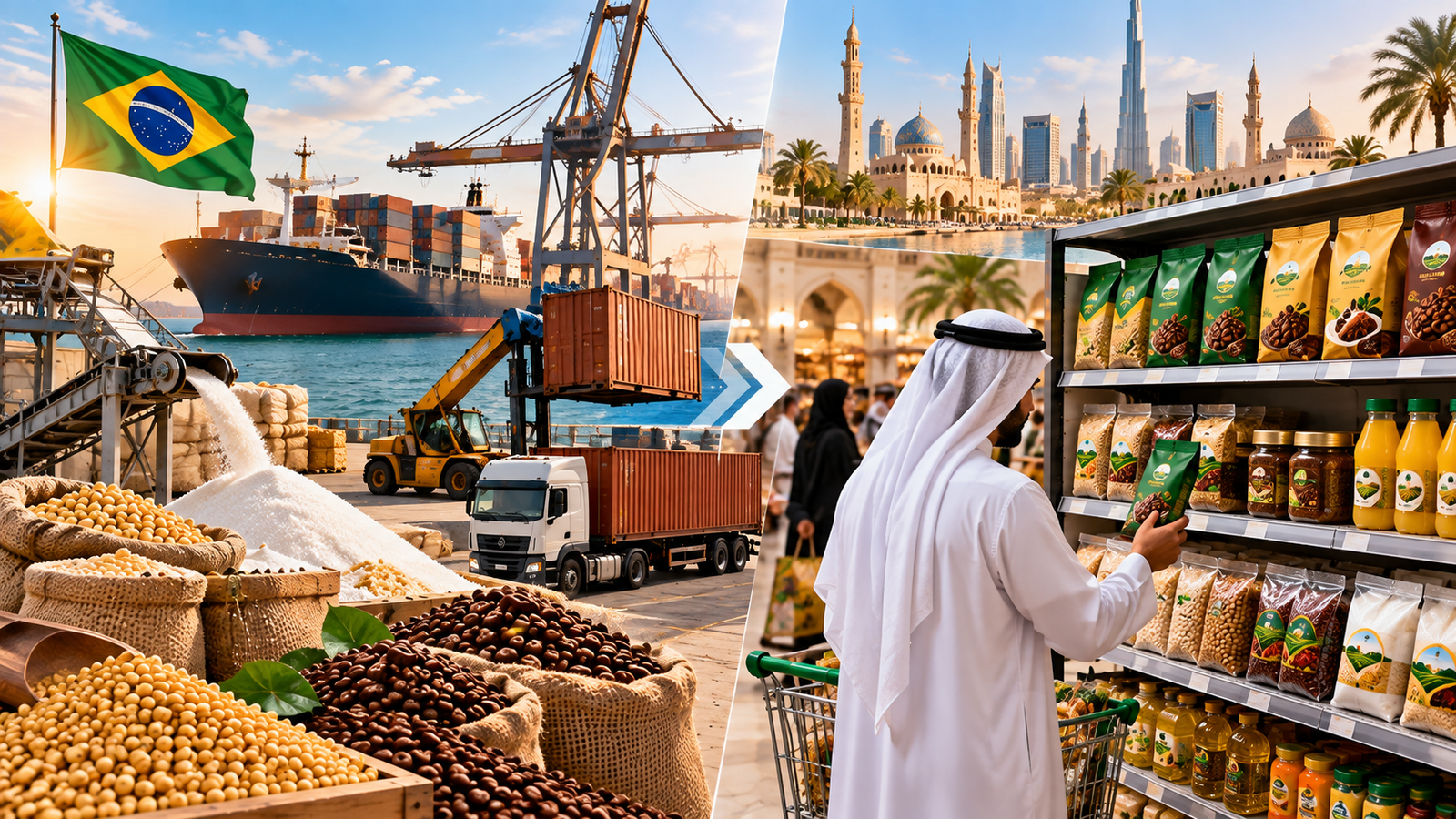
Over the years I have worked in markets such as Syria, Iraq, Lebanon, Sudan and Libya, I have seen this difference firsthand many times.
Brazilian products are present, but in many cases they arrive in bulk or as raw materials. They may then be processed or repackaged in the destination country, or even in a third country, and the final consumer may never know that the product originally came from Brazil.
To understand why this happens, I believe we need to go back a little in history.
Today’s Middle Eastern Trade Cannot Be Understood Without Looking at Its History
The commercial structure of the Middle East was built over decades and, in many cases, over centuries.
After the collapse of the Ottoman Empire, large parts of the Arab world came under mandate systems or strong European influence. Syria and Lebanon were placed under French mandate, while Palestine and Transjordan came under British mandate. Iraq also went through a period of strong British political influence and special political arrangements.
The Sykes-Picot Agreement of 1916 was one important stage in the formation of British and French spheres of influence in the region, although the borders and states we know today were the result of a much broader series of later decisions.
In the Gulf, conditions differed from one territory to another, but British influence was deep. The sheikhdoms that later formed the United Arab Emirates, for example, entered into a series of agreements with Britain from the nineteenth century onward, including exclusive agreements signed in 1892.
Across North Africa, France, Britain and Italy also exercised different forms of colonial rule, protectorate arrangements or political influence.
I am not raising this history in order to make a political argument.
My point is about trade.
The end of direct political or military control did not mean the end of the commercial networks created during those periods.
European companies, banks, commercial representatives, local merchant families, education systems and even the languages used in business remained connected to those established routes for many years.
This is why, for example, the historical French connection can still be seen in Lebanon and Syria in education, language, architecture, business culture and professional relationships.
Many wealthy families, merchants and professionals from these countries studied or did business in Europe. Personal and commercial relationships developed, and many of them continued from one generation to the next.
Within that environment, Latin America — and Brazil in particular — was naturally not at the centre of attention.
The Role of India and South Asia Cannot Be Ignored Either
In the Gulf countries, another historical factor is especially important: the region’s deep connection with the Indian subcontinent.
Contrary to what is sometimes assumed, this relationship did not begin with British influence. It goes back much further.
Historical sources show that South Asian merchants had been active for centuries in Gulf ports, Oman and the wider Indian Ocean trade system, creating extensive commercial networks.
By the nineteenth century, Indian merchants were already playing an important role in Muscat and other Gulf ports.
Later, the large presence of Indians, Pakistanis, Bangladeshis and other South Asian communities in Gulf countries strengthened these networks even further.
When a merchant, an importer or a trading family has worked for decades with India, Pakistan, Britain or France, knows the banks, suppliers and shipping routes, it is only natural that continuing within the same network is easier.
And this is precisely what Brazil lacked in many of these markets:
a historical network, accumulated trust and continuous presence.
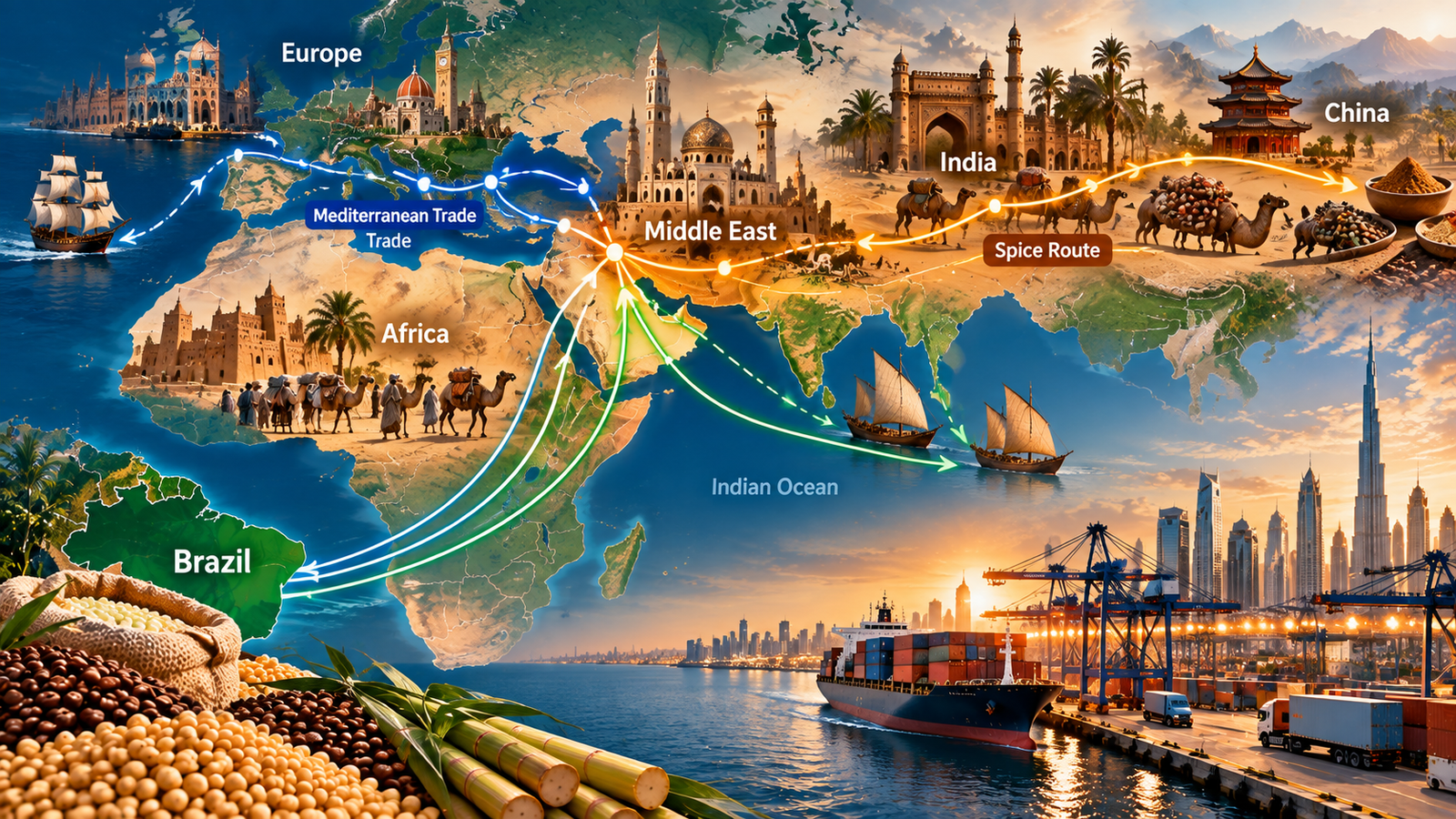
Sometimes a Bottle of Soft Drink Can Explain the History of Trade
One interesting example is Vimto.
The drink was created in Manchester, England, in 1908, and India was among its earliest international markets. In the late 1920s, the Aujan family began distributing Vimto in the Gulf region.
Gradually, the product entered markets including Bahrain, Kuwait, Saudi Arabia, Iraq, the United Arab Emirates and Oman, and later expanded across other Arab countries.
Local production in Saudi Arabia began in 1978.
Today, almost a century later, Vimto has become part of Ramadan consumption culture in several Gulf countries.
The example illustrates an important point:
the success of a product does not depend on quality alone.
Time, continuous presence, distribution networks, market knowledge and a relationship with consumers all play a role in building a brand.
That helps explain why a Turkish chocolate or a European product may hold a much stronger position in an Arab market today than a comparable Brazilian product.
Not necessarily because the Brazilian product is inferior.
But because the other one has been there for much longer.
Iran: A Different Path, but a Similar Result
If we move beyond the Arab countries and look at Iran, we find ourselves facing a very similar question:
Why have Brazilian products and brands never developed a significant presence in the Iranian market, despite Iran’s long history of foreign trade?
Once again, part of the answer lies in history, although Iran followed a very different historical path from the Arab countries.
Iran was never formally colonised by a European power. During much of the nineteenth and early twentieth centuries, however, it stood at the centre of a rivalry between two major powers of the time: Tsarist Russia and Britain.
Russia exerted strong influence from the north, while Britain, driven largely by its interests in India and the Persian Gulf, exercised considerable political and economic influence from the south and east.
This rivalry was not merely political.
Trade, banking, government loans, economic concessions and even Iran’s import and export routes were affected by it.
The numbers help illustrate the scale of that influence.
During the final decades of Qajar rule, around 80% of Iran’s foreign trade, including both imports and exports, was conducted with Russia and Britain or through networks connected to those two powers.
Put simply, a large part of the Iranian market had already developed within a system in which Russia and Britain played dominant roles.
Banking provides a useful example.
The British-owned New Oriental Bank began operating in Iran in 1888, opening branches in several Iranian cities.
A year later, in 1889, its activities were transferred to the Imperial Bank of Persia, also British-owned, which received the exclusive right to issue banknotes and became one of the country’s most important financial institutions for several decades.
Russia soon entered the same space.
The Russian Loan Bank received its concession in 1890 and later effectively came under the control of the Russian Ministry of Finance. In addition to banking, it helped finance trade between Iran, Russia and parts of Eastern Europe.
But the issue went beyond the presence of two foreign banks.
Because of financial difficulties, the Qajar government repeatedly borrowed from foreign institutions and governments. In some cases, Iranian customs revenues were pledged as security for the repayment of those loans.
Naturally, a structure like this also influenced the direction of trade.
When a country’s financial system, credit lines, foreign merchants, transport routes and a significant part of its political relationships remain tied for decades to dominant external powers, imports and exports also tend to follow those established networks.
That does not mean Iran had no trade with other countries.
It means that Russia and Britain possessed a major historical and structural advantage over distant countries such as Brazil.
There was another factor as well.
From the Qajar period onward, much of the Iranian court, economic elite, merchant community and educated classes increasingly looked toward Europe.
Qajar monarchs travelled to Europe, and studying in France, Britain, Germany and other European countries gradually became important for part of the Iranian elite.
Many wealthy and influential families also sent their children to study in Europe.
As a result, human and cultural ties reinforced financial and commercial ones.
For an Iranian merchant of that period, London, Moscow, Istanbul, Paris and later Berlin were part of a familiar network.
Brazil, by contrast, had no established commercial routes with Iran, no network of banks or representatives, no broad educational connection, and at that time its industry had not yet achieved the international position it has today.
Geographical distance and transport limitations also mattered.
Iran did not yet have today’s port infrastructure or regular long-distance logistics capable of supporting extensive trade with a country on the other side of the Atlantic.
Brazil itself was also not yet the industrial power it would later become.
At that time, when people spoke of machinery, industrial goods or technology, European countries — and later Germany and Japan — had far greater international visibility than Brazil.
During the reign of Reza Shah, this situation began to change to some extent.
Bank Sepah began operations in 1925, and Bank Melli Iran was established in 1928.
As Iranian banks expanded, part of the country’s dependence on foreign financial institutions began to decline.
At the same time, economic relations with Germany grew rapidly, and German companies and specialists became increasingly involved in industrial, banking and infrastructure projects.
Yet even these changes did not bring Brazil into Iran’s commercial network.
In practice, as Iran gradually tried to move away from its traditional dependence on Russia and Britain, the space was filled far more by other industrial powers — first Germany, and later the United States and other European and Asian economies — than by Latin America.
So in Iran we arrive at almost the same conclusion as in the Arab countries:
The absence of Brazilian products from the market does not necessarily mean that Brazilian products are weak.
The explanation may be simpler and at the same time deeper:
Brazil was never part of the historical network that helped build that market.
Trade is not only about price and quality.
Routes developed over decades, banks that provide credit, merchants who know one another, students who study abroad, representatives who pass businesses to the next generation and even consumer habits all help shape a market.
For a long time, Brazil was not part of this chain in Iran, just as its direct and continuous presence was limited across much of the Arab world.
And perhaps that is precisely why, today, entering Iran or other markets in the region requires much more than simply finding a buyer for one shipment.
A network has to be built where one did not exist before.
Brazil Exports, but It Does Not Always Build Market Presence
Brazil has long been a major exporting country with strong markets in Latin America, North America, Europe and Asia.
But exporting goods and building a market are not the same thing.
Soybeans, sugar, meat or iron ore can be sold in enormous volumes without the final consumer ever knowing the exporter’s name.
Selling chocolate, biscuits, canned foods, furniture, clothing, cosmetics or a food brand is a different story.
A company needs to understand the market, adapt its packaging to the consumer, study competitors’ prices, find the right distributor or representative, understand the local language and business culture and, above all, maintain a continuous presence.
In my view, one reason Brazil has fallen behind in some of these areas is that, for many years, other markets were already attractive enough for Brazilian companies.
There was less pressure to build independent networks in the Middle East.
Today, however, the situation is different.
Dubai Is Important, but Dubai Is Not the Whole Middle East
Brazil already has important trade infrastructure in Dubai.
ApexBrasil has a commercial presence there, and the Arab-Brazilian Chamber of Commerce also maintains an official office in the city.
These institutions play an important and valuable role.
But one distinction needs to be made.
Trade promotion agencies and chambers of commerce can provide information, create connections, organise trade missions and make market entry easier.
But they do not replace companies in the actual process of selling and exporting.
Ultimately, it is the producer itself that must find the real customer, study the market, set prices, negotiate, adapt the product and build a distribution network.
That is why I believe the idea that “being in Dubai is enough to enter the Middle East” can be misleading.
Dubai is an extremely important hub.
But it is also where Brazil’s major competitors are already present: China, India, Turkey, Europe and many other exporters.
So the Brazilian company once again enters an environment where everyone is competing for the same customers.
There is another approach.
Go directly to the target market.
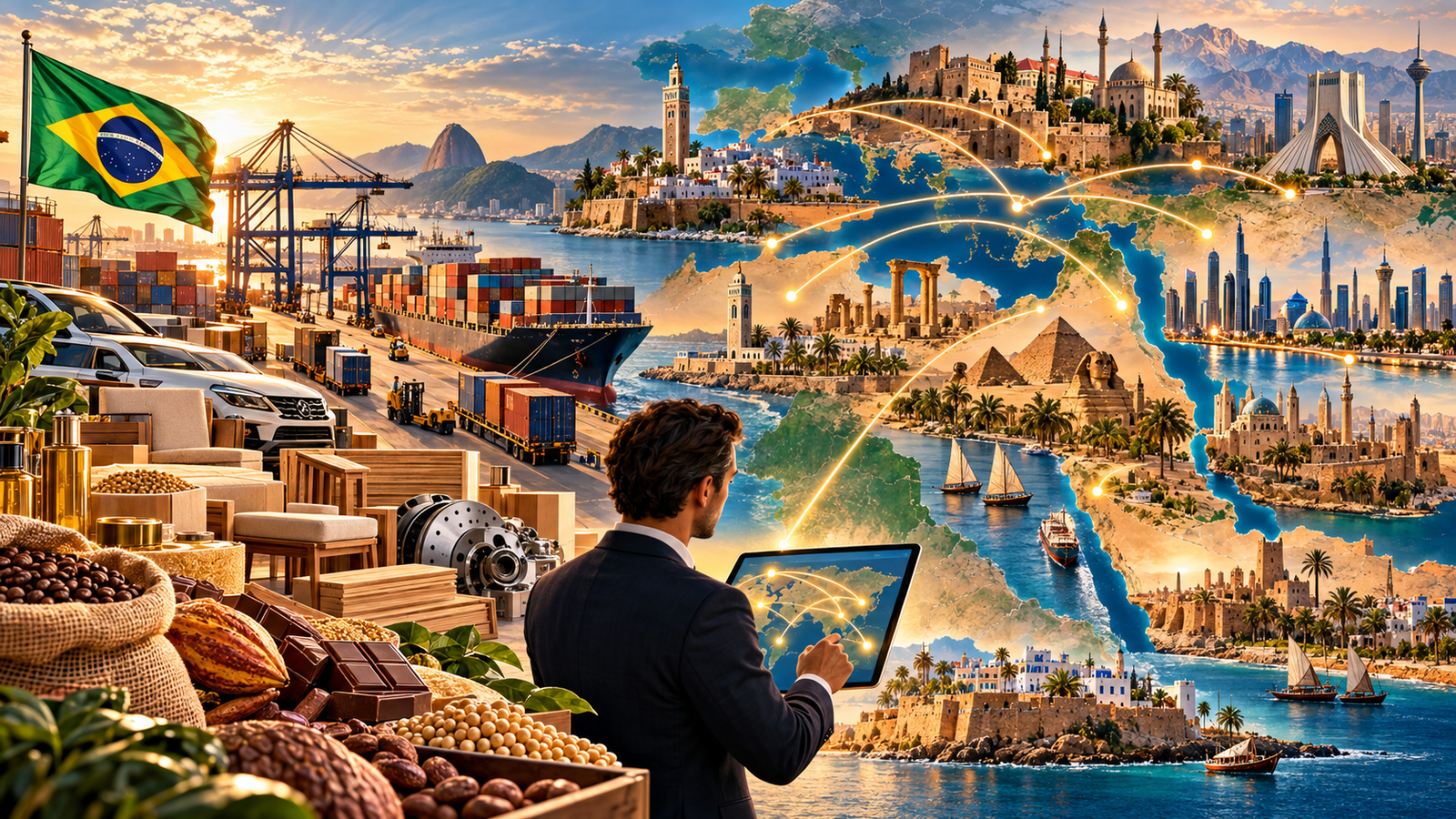
Instead of looking at Syria, Iraq, Saudi Arabia, Oman, Kuwait, Qatar, Jordan, Lebanon, Egypt or Morocco from Dubai, each of these markets should be studied separately.
Identify real and potential customers.
Study competitors’ prices.
Understand market needs, regulations, standards, packaging requirements, distribution channels and consumer behaviour.
And most importantly, this research should not exist only on paper.
The market has to be seen firsthand.
That is where regional experience becomes especially important.
The U.S. Tariff Shock: An Important Reminder
In 2025, another development occurred that, in my view, should serve as a warning to Brazilian exporters.
On April 2, 2025, the U.S. government announced an additional 10% tariff on a broad range of imports, taking effect on April 5.
Then, on July 30 of the same year, another order concerning Brazil imposed an additional 40% tariff on certain Brazilian products.
Where both measures applied, the total additional tariff could reach 50%.
The measure, however, included numerous exceptions.
The U.S. government stated in the order that the decision was related to policies and actions of the Brazilian government.
Since then, the tariff structure has changed again.
So my point is not to say that every Brazilian product today faces a 50% tariff in the United States.
That would not be accurate.
The point is different.
A large and long-established market can suddenly change because of a political or commercial decision.
Market diversification is therefore not only an opportunity to increase sales.
It is also part of export risk management.
The Gulf Crisis and the Question of Food Security
In 2026, the crisis in the Gulf region once again demonstrated how closely food security depends on trade and transport routes.
Countries across the Middle East and North Africa structurally depend on imports for a significant share of their food supply.
That dependence makes them vulnerable to disruptions in supply chains and major transport routes.
For Brazil, this is not merely a political or regional development.
Brazil is one of the world’s largest food producers.
Whenever food security, diversification of supply sources and the creation of more reliable supply chains become priorities, Brazil should be among the countries considered more seriously.
But once again, I would stress that the real opportunity is not simply to sell another shipment of sugar or soybeans.
The real opportunity begins when Brazil stays in the market.
When consumers recognise a product as Brazilian.
When importers know they can work directly with a Brazilian producer.
When Brazilian companies stop understanding a market only through export statistics and begin to know who their customer is, who their competitor is, what price their product should carry and on which shelf it will actually be placed.
Perhaps It Is Time to Narrow This Historical Gap
Brazil cannot change the commercial history of the Middle East.
It cannot reduce the geographical distance between itself and the region.
And it cannot, in only a few years, replace networks that other countries spent decades — sometimes a century — building.
But it can begin to follow a different path today.
In my view, that path starts with a simple change in perspective:
The Middle East should not be seen as a single export destination. It should be understood as a collection of independent markets.
Iraq is not the same market as Saudi Arabia.
Oman is not the same market as Egypt.
Lebanon is not the same market as Morocco.
And Iran, with its own history, economic structure, business culture and specific conditions, is a different market from all of them.
Each country has its own business culture, distribution networks, consumer needs, regulations and opportunities.
If Brazilian producers work alongside people who genuinely understand these markets, conduct serious field research, identify direct customers and build long-term relationships, part of the historical distance between Brazil and the region can be reduced.
And perhaps that is the real goal:
not simply to increase the value of Brazilian exports to the region, but to reach a day when, in a supermarket in Baghdad, Beirut, Riyadh, Muscat, Doha or Tehran, alongside Turkish, Indian and European products, a Brazilian brand is equally familiar to the consumer.
That is when we will be able to say that Brazil no longer simply exports to the Middle East.
It has become part of the market.
Houshang Abbassi